



How Ghana Import Duties Really Work: A Complete Breakdown
Understand how import duties, VAT, and levies are calculated on goods shipped from China to Ghana — CIF value, HS codes, duty rates, and the full tax stack explained simply.
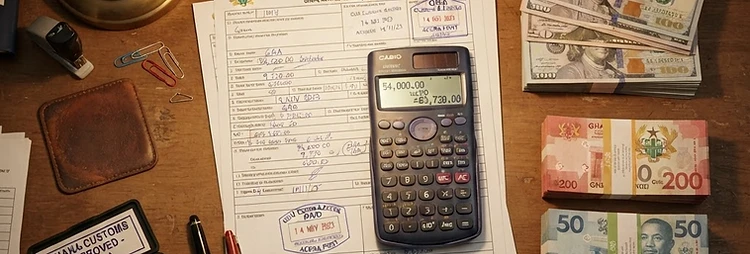
Import Duties: The Part That Confuses Everyone
Import duties are the taxes you pay when goods enter Ghana. They're the single biggest variable cost in the China-to-Ghana shipping process — and the one that catches most new importers by surprise. You might find a great deal on products in China, only to discover that duties and taxes add 30%, 40%, or even 50% to your total cost by the time the goods reach you.
The good news is that import duties are predictable. Once you understand how the calculation works — the CIF value, the HS code, the duty rate, and the stack of additional taxes — you can estimate your total landed cost before you even place your order. This guide explains every component in plain language, shows you a worked example, and answers the questions importers ask most.
Step 1: The CIF Value — What Duties Are Based On
All Ghana import duties are calculated on the CIF value of your shipment. CIF stands for Cost, Insurance, and Freight:
Important: Because freight is included in the CIF value, your shipping method affects your duty bill. Air freight is more expensive than sea freight, so the same goods shipped by air will have a higher CIF value and therefore a slightly higher duty bill. This is another reason sea freight is more economical for most shipments.
Step 2: The HS Code — What Determines Your Duty Rate
Every product in international trade is classified under an HS (Harmonized System) code — a standardized numbering system used by customs authorities worldwide. The first 6 digits are international; Ghana adds additional digits for local classification. Your product's HS code determines the import duty rate that applies.
Duty rates vary widely by product category. Here are some common ranges:
| Product Category | Typical Duty Rate |
|---|---|
| Electronics (phones, laptops, accessories) | 10%–20% |
| Clothing and textiles | 20% |
| Footwear | 20%–30% |
| Furniture and home goods | 10%–20% |
| Building materials | 5%–20% |
| Food and beverages | 20%–35% |
| Cosmetics and beauty products | 20% |
| Machinery and equipment | 5%–10% |
| Vehicles and auto parts | 5%–35% |
| Books and educational materials | 0% (often exempt) |
These are approximate ranges — the exact rate depends on the specific HS code. We classify your products accurately as part of our customs clearance service.
Step 3: The Full Tax Stack — Every Charge Explained
Import duty is just one of several charges you'll pay. Here's the complete stack of taxes and levies applied to imports into Ghana:
Import Duty
The main import tax, determined by your product's HS code. This is the biggest variable in your total cost.
NHIL (National Health Insurance Levy)
A levy funding the National Health Insurance Scheme, charged on the CIF value.
GETFund Levy
A levy funding the Ghana Education Trust Fund, charged on the CIF value.
VAT (Value Added Tax)
The general consumption tax. Calculated on a compound basis — it's charged on the CIF value PLUS the import duty PLUS the NHIL and GETFund levies.
COVID-19 Health Recovery Levy
A recovery levy introduced during the pandemic, calculated on the same compound base as VAT.
ECOWAS Levy
A regional levy supporting the Economic Community of West African States.
EDIF (Export Development & Investment Fund)
A levy supporting export development and investment in Ghana.
Processing & Examination Fees
Fixed administrative fees for customs processing and any physical examination.
A Worked Example: Calculating Total Duties
Let's walk through a real example. Say you import electronics from China with a goods value of $1,000 and a sea freight cost of $200 (no separate insurance). Here's how the duties would stack up:
| Component | Calculation | Amount |
|---|---|---|
| Goods Value (Cost) | Invoice from supplier | $1,000.00 |
| Freight | Sea freight cost | $200.00 |
| CIF Value | Cost + Freight | $1,200.00 |
| Import Duty (15%) | 15% × $1,200 | $180.00 |
| NHIL (2.5%) | 2.5% × $1,200 | $30.00 |
| GETFund (2.5%) | 2.5% × $1,200 | $30.00 |
| VAT (15%) | 15% × ($1,200 + $180 + $30 + $30) | $216.00 |
| COVID Levy (1%) | 1% × ($1,200 + $180 + $30 + $30) | $14.40 |
| ECOWAS (0.5%) | 0.5% × $1,200 | $6.00 |
| EDIF (0.5%) | 0.5% × $1,200 | $6.00 |
| Total Duties & Taxes | $482.40 |
In this example, the total duties and taxes come to $482.40 on a CIF value of $1,200 — that's about 40% of the CIF value added in taxes. Your total landed cost (goods + freight + duties) would be $1,682.40. This is why it's critical to factor duties into your pricing before you order.
Tips for Managing Your Import Duty Costs
Calculate your total landed cost before ordering — goods + freight + duties = your true cost
Ensure accurate HS code classification — some similar products have very different duty rates
Declare the true transaction value — under-declaring is illegal and risks seizure and fines
Choose sea freight over air freight when possible — lower freight cost means lower CIF value and lower duties
Ask for a duty estimate before shipping — we can estimate your total tax burden upfront
Factor duties into your selling price — don't get caught short when the bill arrives
Keep all documentation accurate and consistent — invoice, packing list, and declaration must match
How Welkies Handles Your Duties
We classify your products under the correct HS codes
We calculate the CIF value and estimate all duties and taxes before clearance
We provide a transparent cost breakdown so you know exactly what you're paying
We pay the duties to Ghana Customs on your behalf
We include the duty amount in your invoice — no separate port visits needed
We handle any customs queries or valuation reviews during clearance
Frequently Asked Questions
Want a Duty Estimate for Your Shipment?
Tell us what you're importing and its value — we'll estimate your CIF value, classify the HS codes, and calculate your total duty and tax burden before you ship.