

Shipping Container Sizes Explained: 20ft, 40ft & 40HC
A practical guide to shipping container dimensions, capacities, and how to choose the right container size for your China-to-Ghana shipment.
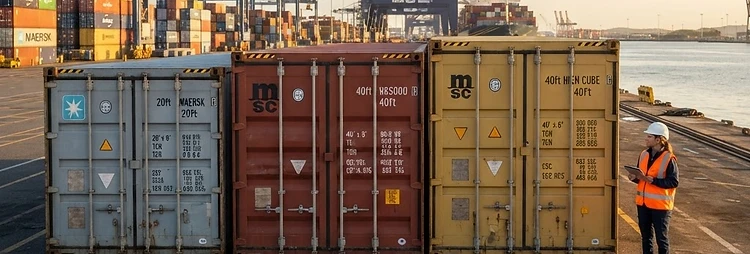
Why Container Size Matters
When you ship goods by sea from China to Ghana, your cargo travels in a standard shipping container. The three most common sizes are 20ft, 40ft, and 40ft High Cube (40HC). Understanding the difference between them helps you estimate how much your shipment will cost, how much space you need, and whether consolidation (sharing a container) or a full container is the right choice for you.
If you're a small or medium importer using consolidation (LCL), the container size mostly affects the overall cost structure — you pay per CBM regardless. But if you're shipping enough cargo to fill (or nearly fill) a container, choosing the right size can save you significant money. This guide breaks down each container type, its dimensions, capacity, and when to use it.
Container Sizes at a Glance
| Specification | 20ft | 40ft | 40HC |
|---|---|---|---|
| External Length | 6.06 m | 12.19 m | 12.19 m |
| External Width | 2.44 m | 2.44 m | 2.44 m |
| External Height | 2.59 m | 2.59 m | 2.90 m |
| Internal Length | 5.90 m | 12.03 m | 12.03 m |
| Internal Width | 2.35 m | 2.35 m | 2.35 m |
| Internal Height | 2.39 m | 2.39 m | 2.70 m |
| Capacity (CBM) | ~33 CBM | ~67 CBM | ~76 CBM |
| Max Payload (kg) | ~28,000 kg | ~26,500 kg | ~26,500 kg |
| Door Opening Height | 2.28 m | 2.28 m | 2.58 m |
| Best For | Heavy, dense cargo | Standard volume | Tall / bulky cargo |
The 20ft Container
The 20ft container is the smallest standard shipping container, measuring about 6 meters long. It has a capacity of roughly 33 CBM and a maximum payload of about 28,000 kg. Despite being half the length of a 40ft container, it can actually carry more weight — making it ideal for dense, heavy cargo like tiles, cement, steel, or machinery where you'll hit the weight limit before filling the volume.
Best for: Heavy, dense cargo where weight matters more than volume — building materials, metal products, machinery, and industrial goods.
The 40ft Container
The 40ft container is twice the length of a 20ft, measuring about 12 meters long. It has a capacity of roughly 67 CBM — double the volume of a 20ft — but a similar maximum payload of about 26,500 kg. This makes it better suited for lighter, bulkier cargo where volume is the primary concern. The 40ft is the workhorse of global shipping and is commonly used for general merchandise, furniture, textiles, and consumer goods.
Best for: Standard-volume cargo — furniture, appliances, textiles, general merchandise, and medium-density goods.
The 40ft High Cube (40HC)
The 40HC is identical in length and width to a standard 40ft container but is about 30cm taller, giving it roughly 12% more volume — about 76 CBM. This extra height makes it the most popular container for China-to-Ghana consolidation because it fits more customers' goods per shipment, which keeps per-CBM costs lower for everyone. It's especially good for tall cargo, stackable goods, and lightweight but bulky items.
Best for: Tall or stackable cargo, bulky lightweight goods, and consolidation shipping where maximizing volume per container matters most.
How to Choose the Right Container Size
If you're using consolidation (LCL)
The container size doesn't directly affect you — you pay per CBM regardless. We handle the container selection and use 40HC containers to maximize efficiency and keep your costs low.
If you have enough cargo for a full container (FCL)
Calculate your total CBM. If it's over ~55 CBM, a 40ft or 40HC is more cost-effective than two 20ft containers. If your cargo is very heavy and dense, a 20ft may be better because of its higher weight capacity.
If your cargo is tall or bulky
Choose a 40HC — the extra 30cm of height can make the difference between fitting your goods in one container or needing two. Tall furniture, large appliances, and stackable cartons all benefit from the extra height.
Understanding CBM: The Key to Container Costs
CBM (cubic meters) is the unit used to measure cargo volume — and it's how sea freight from China to Ghana is billed. Understanding how to calculate it helps you estimate your shipping cost before you even order.
The formula:
CBM = Length (m) × Width (m) × Height (m)
Example 1: A carton measuring 100cm × 50cm × 40cm = 1.0 × 0.5 × 0.4 = 0.2 CBM
Example 2: A carton measuring 60cm × 40cm × 30cm = 0.6 × 0.4 × 0.3 = 0.072 CBM
Example 3: 10 cartons at 0.2 CBM each = 2.0 CBM total
Use our freight calculator to estimate your shipping cost based on your total CBM and cargo category.
Special Container Types
Beyond the standard dry containers, there are specialized container types for cargo that doesn't fit the standard profile:
Open Top Container
No solid roof — cargo is loaded from the top using a crane and covered with a tarpaulin. Used for tall or oversized cargo that won't fit through standard container doors.
Flat Rack Container
No walls — just a platform with folding end walls. Used for heavy machinery, vehicles, and oversized equipment that needs to be loaded from the side.
Reefer (Refrigerated) Container
Temperature-controlled container for perishable goods like food, pharmaceuticals, and chemicals that need to stay cold during transit.
Tank Container
A frame holding a cylindrical tank for transporting liquids — chemicals, food-grade liquids, and industrial fluids.
Frequently Asked Questions
Need Help Choosing a Container?
Tell us what you're shipping and we'll help you figure out the right container size and estimate your shipping cost from China to Ghana.